


The inhabitants of the Minett love their region and identify the environment, housing and mobility as priorities
As part of the new territorial cooperation agreement between the State and the PRO-SUD Syndicate, a representative survey carried out by Ilres among 837 inhabitants of the eleven municipalities of the Minett highlights a region that is highly appreciated by its inhabitants, but also one that faces clear expectations in terms of territorial development.
The survey, which was designed and carried out in collaboration with the Ministry of Housing and Spatial Planning, was conducted in February and March. The survey aimed to gain a better understanding of how the residents of the Minett perceive their region, their quality of life, their knowledge of regional structures and their priorities for the coming years.
The results constitute an important basis for the development of the new territorial cooperation agreement between the State and the PRO-SUD Syndicate, confirms Christian Weis, president of the PRO-SUD Syndicate:
“This survey confirms the strong attachment of the inhabitants to the Minett and their positive perception of the quality of life in the region. It also shows that expectations are very concrete: the environment, affordable housing, mobility and citizen information are among the priorities. These results provide a valuable basis for building, together with the eleven municipalities, a shared strategy for spatial planning, development and territorial promotion adapted to the specific needs of our region.”
The objective of this agreement is to strengthen a coordinated approach to regional development, taking into account the specific characteristics of the territory, the needs of the municipalities, national and cross-border dynamics, as well as the expectations expressed by inhabitants. The survey therefore makes it possible to complement institutional reflections with a citizen-based reading of the region and its challenges.
A widely recognised quality of life and a region recommended by its inhabitants
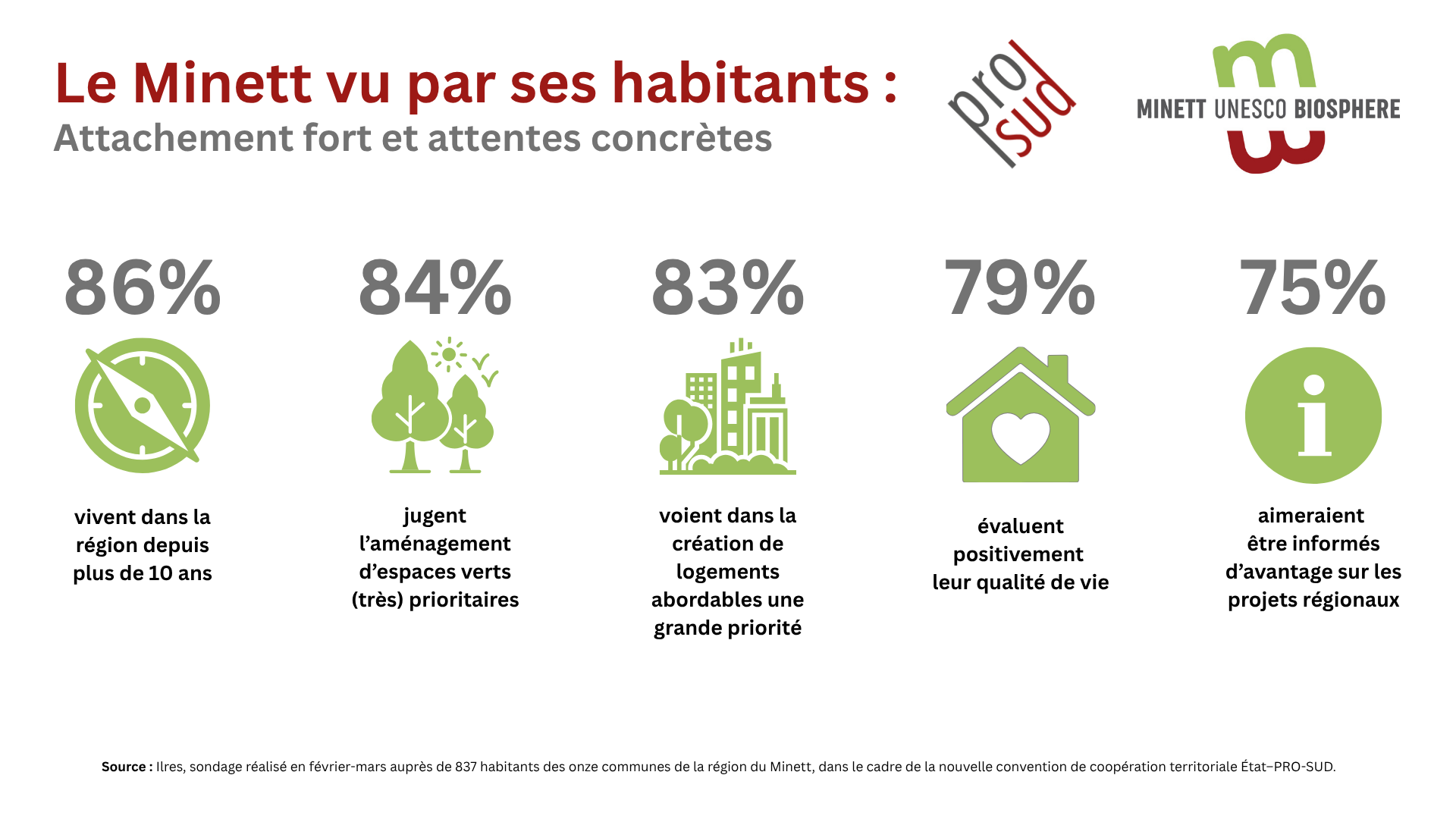
The survey results first confirm a high level of satisfaction with the quality of life in the Minett. 79% of respondents give the quality of life in the region a score between 7 and 10, including 23% who give it a score of 9 or 10. This positive perception is accompanied by strong local roots. Indeed, 86% of respondents have lived in the Minett for more than ten years or have always lived there. These results underline a strong connection between inhabitants and their territory.
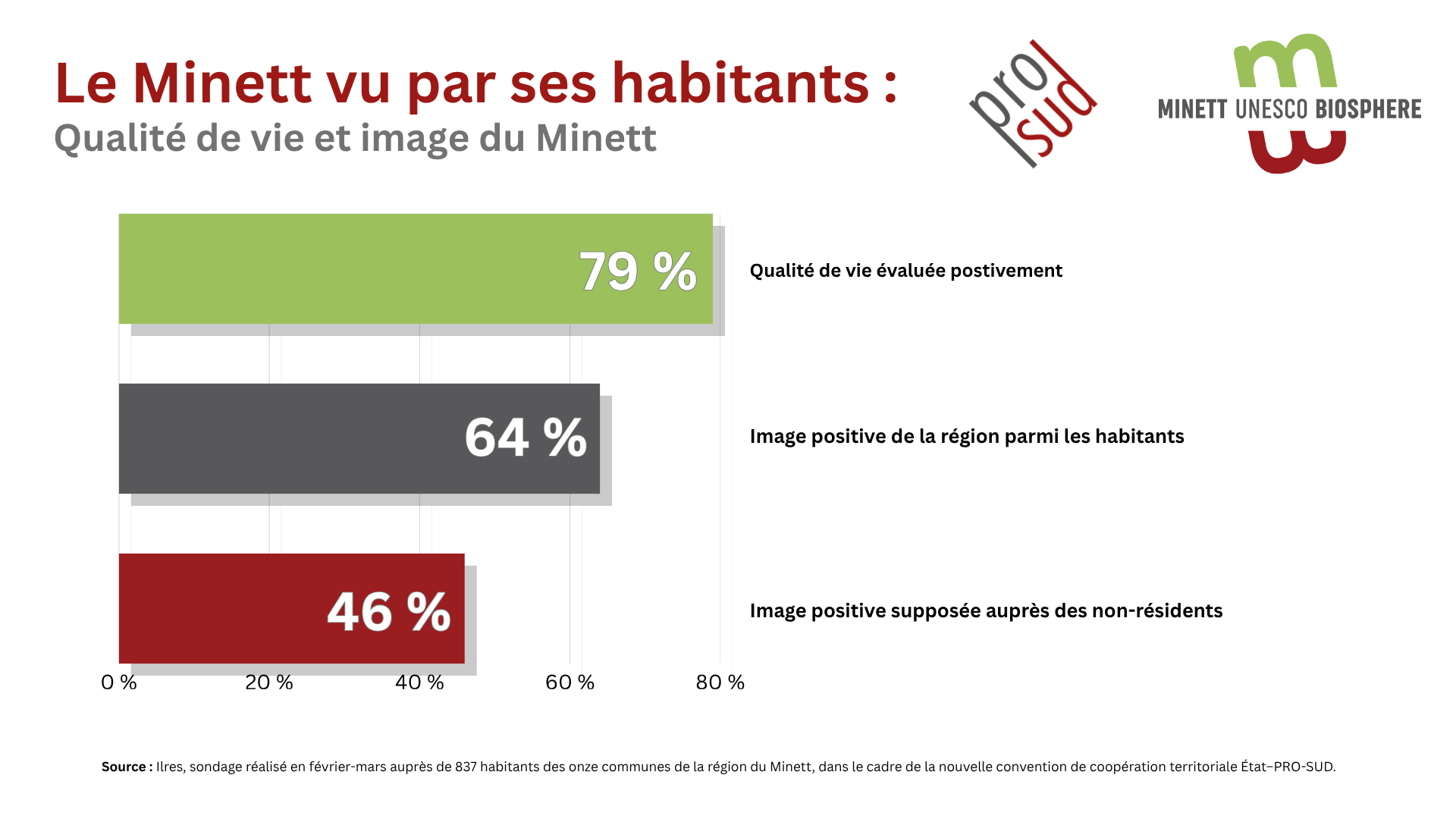
The image of the region is also predominantly positive among its inhabitants. Around 64% of respondents express a favourable perception of the Minett. However, the survey highlights a gap between the lived image of the region and the image presumed to exist outside it. Only 46% of respondents believe that the Minett enjoys a positive image among people who do not live in the region. This result shows that work on promotion and communication remains necessary in order to better publicise the territory’s assets beyond its regional borders.
The inhabitants do not merely say they are satisfied with living in the Minett: many of them also recommend the region. Depending on the activities considered — living there, working there, visiting the region or taking part in cultural activities there — between 65% and 71% of respondents place themselves in the most positive levels of recommendation.
Rejection remains very limited: only 4% to 6% of inhabitants state that they would “not at all” recommend the region. These results confirm that the Minett benefits from a significant capital of attachment among its inhabitants. They also show that this positive image can serve as a lever to strengthen the region’s residential, economic, cultural and tourist attractiveness.
Uses mainly linked to everyday life
The activities regularly practised in the Minett are above all linked to everyday life. Inhabitants mainly mention purchases and shopping, cited by 76% of respondents, followed by meeting family or friends, at 75%, as well as sport and outings in nature, at 70%. Restaurants and bistros are also cited by 61% of respondents.
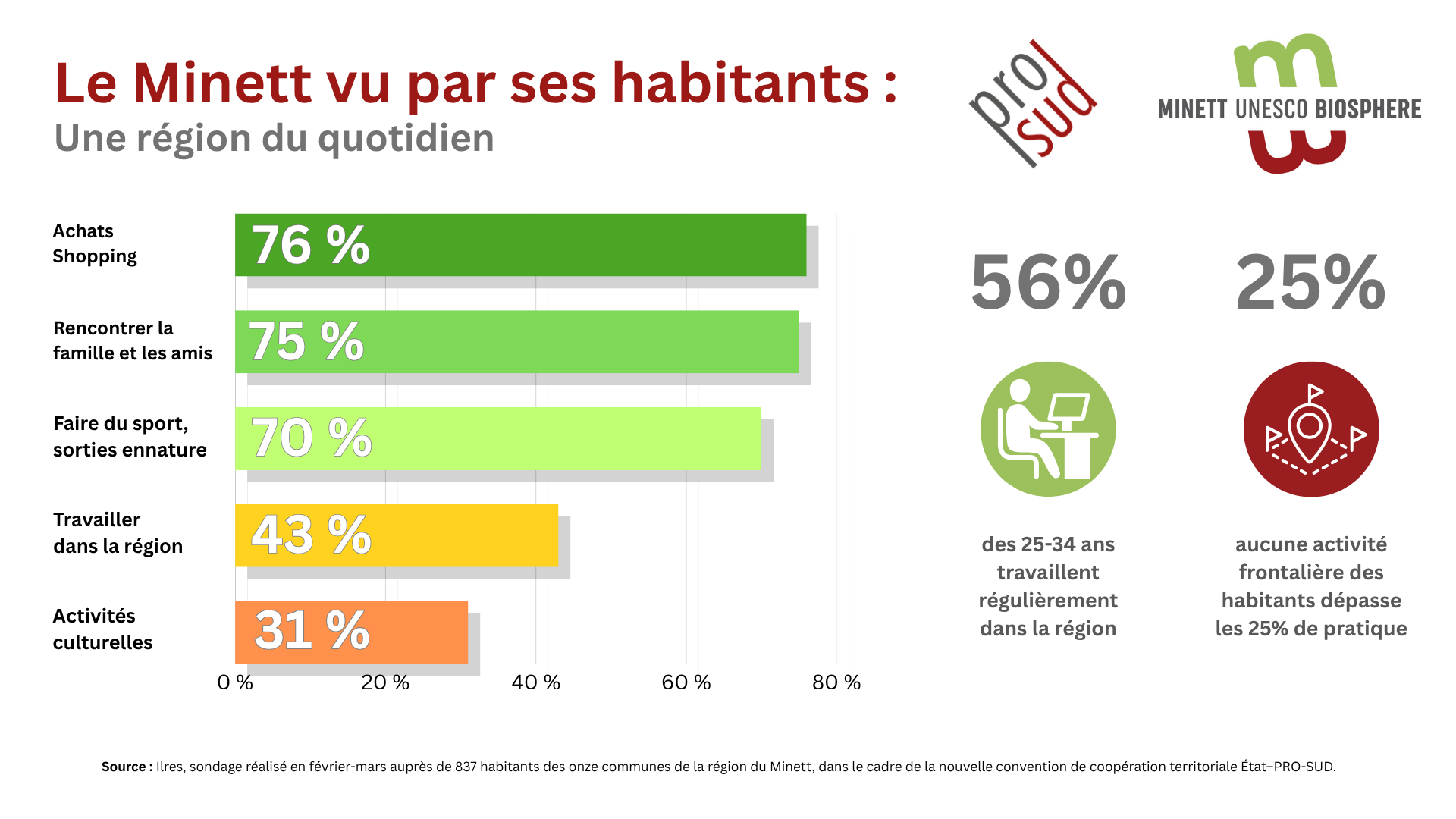
Cultural activities appear to be less frequent: 31% of inhabitants say they practise them regularly, while 18% say they never do so. From a professional perspective, 43% of respondents state that they work in the region. This proportion is particularly high among 25- to 34-year-olds, 56% of whom often or regularly work in the Minett.
Cross-border activities, by contrast, remain relatively limited. No activity outside the region is regularly practised by more than 25% of respondents. Shopping in the French or Belgian border areas is the external activity most often mentioned, at 23%.
Regional structures: making common projects better known
The survey shows that knowledge of regional structures can still be strengthened. 30% of inhabitants say they know the PRO-SUD Syndicate. In-depth knowledge of the syndicate remains limited: 30% of respondents state to know PRO-SUD, only 5% of tem say they know the structure well.
The Minett UNESCO Biosphere, for its part, enjoys real visibility, but there is still room for improvement. 36% of inhabitants say they know it. Among those who know the Minett UNESCO Biosphere, 72% know that their municipality is part of the UNESCO perimeter. Respondents also rate the potential positive impact of the label on the image of the region at 6.7 out of 10. These results confirm that the Minett UNESCO Biosphere constitutes an important lever for strengthening territorial identity, the visibility of the Minett and the promotion of its landscapes, biodiversity and natural and industrial heritage.
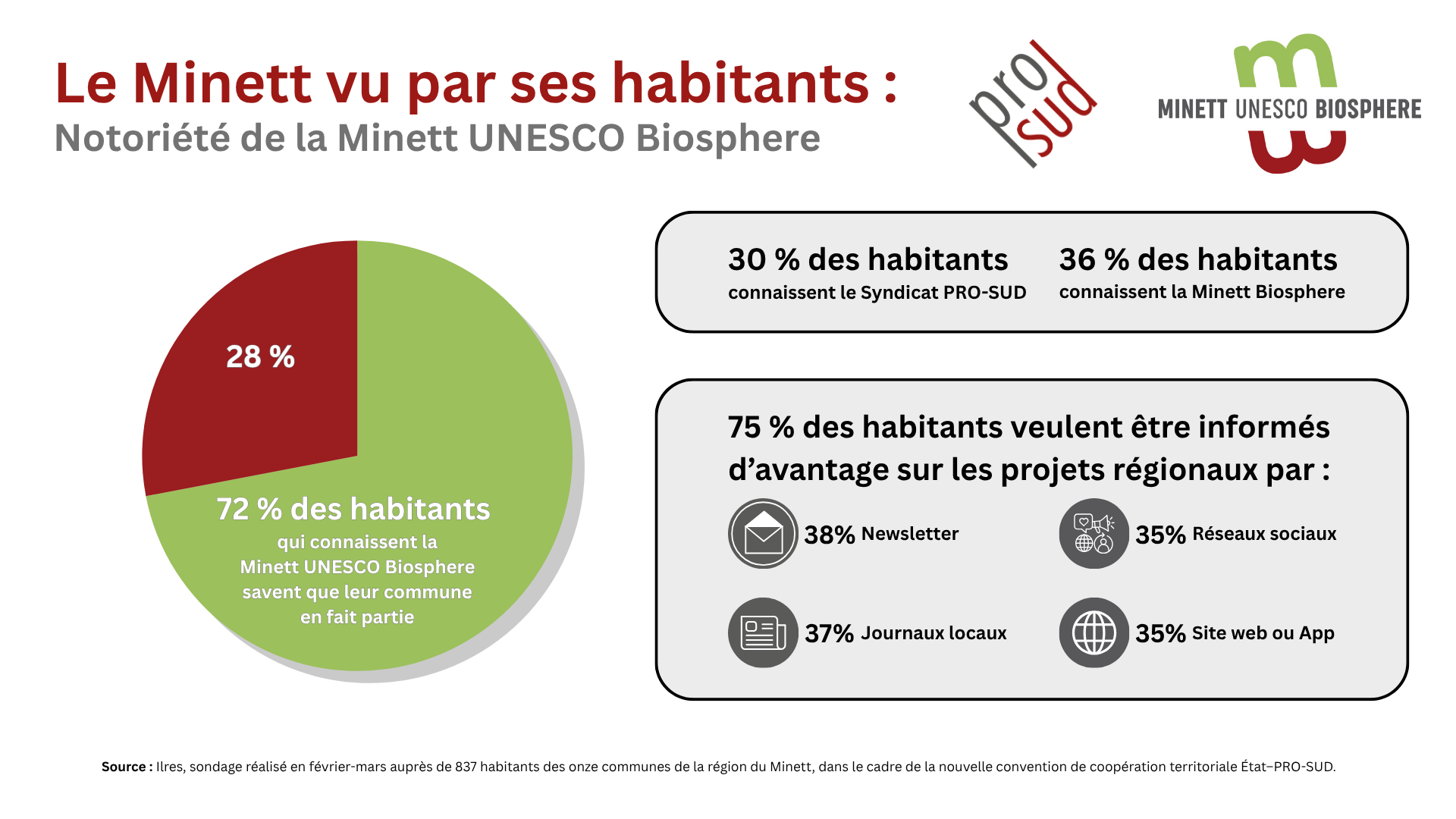
This finding ties in with another important result: 75% of inhabitants express a desire to be better informed about regional projects. The survey therefore highlights a major communication challenge concerning the role of regional structures, their missions, their projects and cooperation between the eleven municipalities of the South.
The survey also reveals a marked interest in information and citizen participation. 41% of inhabitants would like to be able to express their views on and about the projects of PRO-SUD and the Minett UNESCO Biosphere.
The preferred consultation formats are mainly flexible and accessible. 59% of respondents mention questionnaires or surveys, while 47% mention online consultations. In-person formats are mentioned less often: 31% for public meetings and 24% for participatory workshops.
To receive information about local and regional projects, inhabitants favour several complementary channels: e-mail newsletters, cited by 38%, local newspapers and municipal bulletins, at 37%, and social networks, at 35%.
Biodiversity, housing and climate adaptation at the top of expectations
The survey results show that inhabitants attach great importance to projects related to the environment, biodiversity, climate and living environment. The development of green spaces in towns and localities emerges as one of the strongest priorities: 84% of respondents consider this action to be a priority or a high priority.
Inhabitants also express significant concerns regarding pollutants in food, water quality, the effects of climate change and soil sealing. The adaptation of towns to extreme heat, flooding and drought therefore appears to be an important issue for the future development of the region.
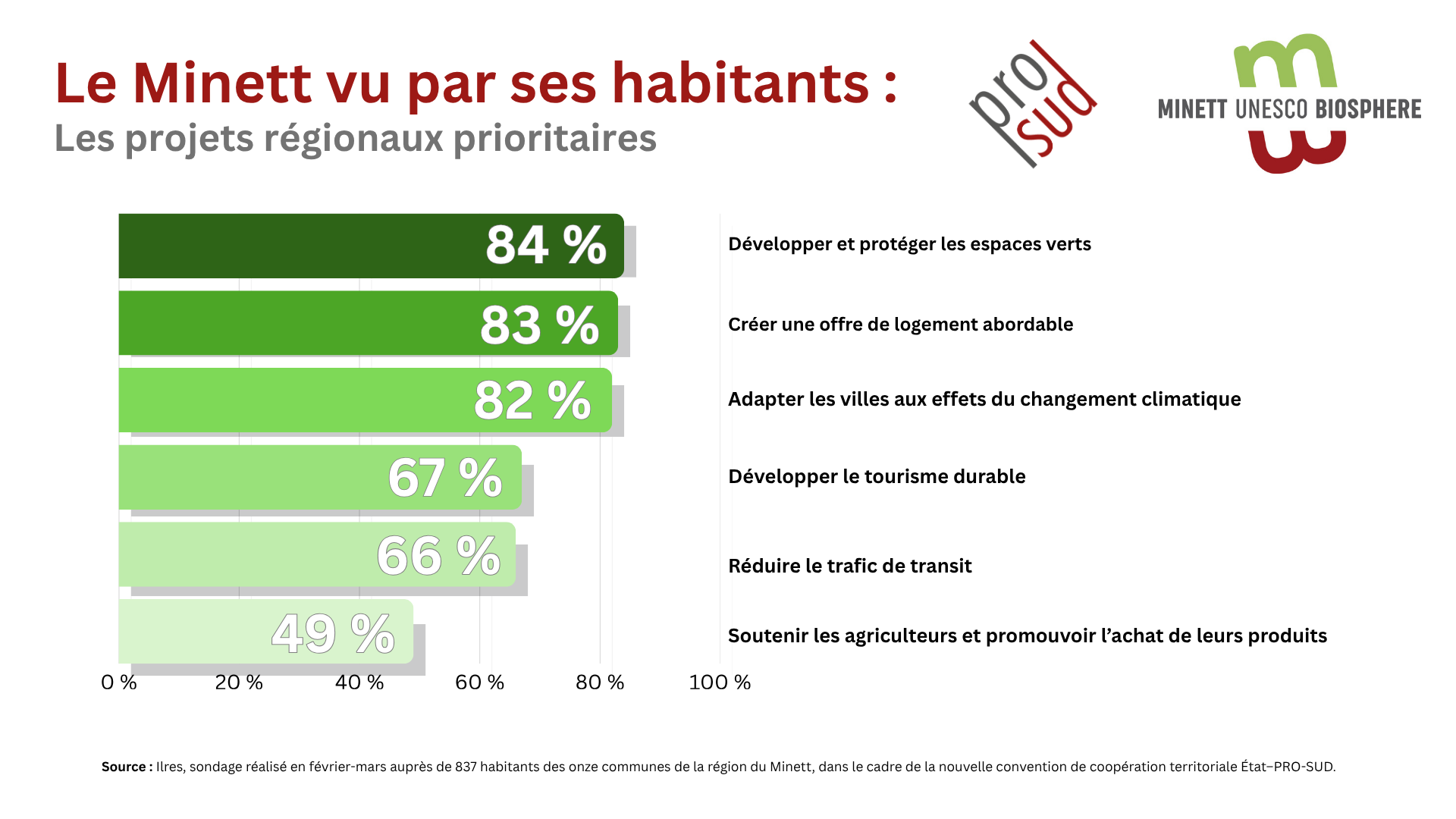
The survey also highlights interest in sustainable tourism, particularly in connection with former open-cast mines, the Minett UNESCO Biosphere and initiatives such as the Minett Trail. The development of sustainable tourism is considered a priority or a high priority by 67% of inhabitants.
Housing appears as another priority theme. While 69% of respondents say they are satisfied with their current housing, expectations regarding housing policy are very high. The development of affordable housing is considered a very high priority by 52% of respondents and a priority by 31%, making 83% in total.
Other actions related to housing and urban development are also considered important, notably the use of empty buildings and vacant land, as well as the revitalisation of town centres. These results reflect a strong expectation in favour of regional development that combines quality of life, access to housing, efficient use of existing land resources and the attractiveness of localities.
Mobility: between dominant car use and expectations regarding intermodality
Mobility constitutes a third major axis of regional concerns. The private car remains the most widely used means of transport, with 69% of respondents stating that they use it. Public transport is used by 51% of inhabitants, while 40% say they travel on foot. Other modes remain less frequent: 16% say they carpool and 12% use a bicycle.
The public transport offer is generally rated positively: 61% of inhabitants consider it to be well or very well developed. This perception is particularly positive among 16- to 24-year-olds, who are also the biggest users of public transport.
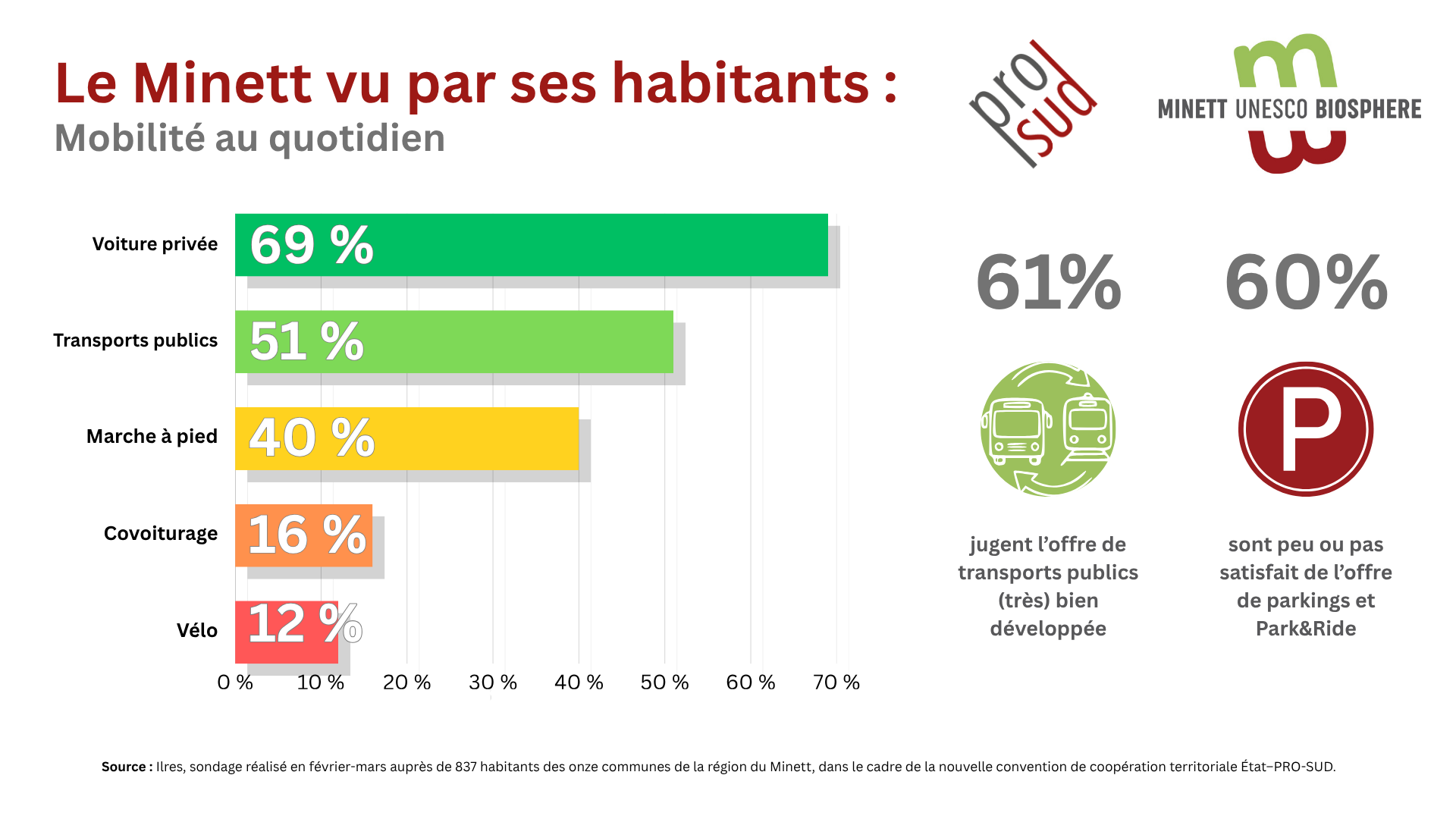
Parking, however, appears to be a point of tension. 60% of inhabitants say they are little or not at all satisfied with the parking offer, with even higher levels of dissatisfaction in certain highly urbanised municipalities.
For future projects, intermodality emerges as a strong priority. Making it easier to switch from one means of transport to another — bicycle, train, bus or walking — is considered a priority or a high priority by 72% of Luxembourgish residents and 80% of non-Luxembourgish residents of the Minett. Reducing transit traffic is also considered a priority by 66% of inhabitants.
A solid basis for the future territorial strategy
Overall, the survey confirms that the Minett is a region to which its inhabitants are deeply attached. The quality of life there is largely recognised, local roots are strong, and the region benefits from significant potential in terms of identity, nature, heritage and sustainable development.
The results also highlight several clear expectations: strengthening green spaces, preserving the environment, developing affordable housing, improving intermodality, reducing transit traffic, better promoting the Minett UNESCO Biosphere and better informing citizens about regional projects.
Click here to consult the survey in detail.