



A biosphere reserve is not a closed-off nature park. It is a living model territory where people, nature, research, education and sustainable development come together.
A territory where people and nature are considered together
When people hear the word “biosphere”, they often first think of untouched nature, forests, rare species or protected landscapes. However, a UNESCO Biosphere Reserve is much more than a classic protected area. It is a territory in which the relationship between people and their environment is consciously shaped, studied and developed.
The basic idea is both simple and ambitious: nature should be protected without excluding people from the landscape. Quite the opposite. Biosphere reserves show how municipalities, residents, science, education, business and politics can work together to develop solutions that reconcile biodiversity, quality of life and sustainable development. UNESCO therefore describes biosphere reserves as “living laboratories for sustainable development”, meaning places of learning and experimentation for sustainable development.
For the Minett UNESCO Biosphere, this approach is particularly relevant. Southern Luxembourg is not a “wild” natural landscape in the classical sense, but a densely populated, culturally diverse region strongly shaped by its industrial past. Precisely for this reason, it is an ideal example of how nature can return to a landscape shaped by human activity, and how a former industrial area can become a model territory for sustainable regional development.
 |
The origins of the idea: UNESCO’s MAB Programme
The idea of biosphere reserves emerged within the framework of UNESCO’s Man and the Biosphere (MAB) Programme. This programme was launched in 1971 with the aim of creating a scientific basis for improving the relationship between people and their environment. It brings together natural sciences, social sciences, economics and education in order to improve living conditions while protecting both natural and human-managed ecosystems.
At the time, this was a very modern approach. Nature conservation was no longer understood only as separation or exclusion, but as part of a broader process of societal development. The programme does not only ask: “How do we protect nature?” It also asks: “How can people live, work, produce, learn and plan within a territory while preserving natural resources?”
Today, the MAB Programme is one of the most important international instruments for connecting local experiences with global challenges. Climate change, biodiversity loss, urbanisation, energy consumption, sustainable tourism, environmental education and regional identity are all topics that can be addressed concretely within biosphere reserves.
From concept to concrete territory
A biosphere reserve is not simply defined “from the outside”. It is proposed by a state, remains under the sovereignty of the country concerned and is internationally recognised within the framework of the MAB Programme. The designation is made by UNESCO on the basis of decisions taken by the International Coordinating Council of the MAB Programme.
It is important to underline that a biosphere reserve is not a fixed label. Its functioning is regularly reviewed. UNESCO provides for a periodic review every ten years. This review analyses, among other things, how the territory functions, its zoning, the involvement of the population and the relevance of the objectives that have been set.
A biosphere reserve is therefore always also a process. It is not only about obtaining a status, but about bringing that status to life through concrete projects, partnerships, research, education and citizen participation.
The three main missions of a biosphere reserve
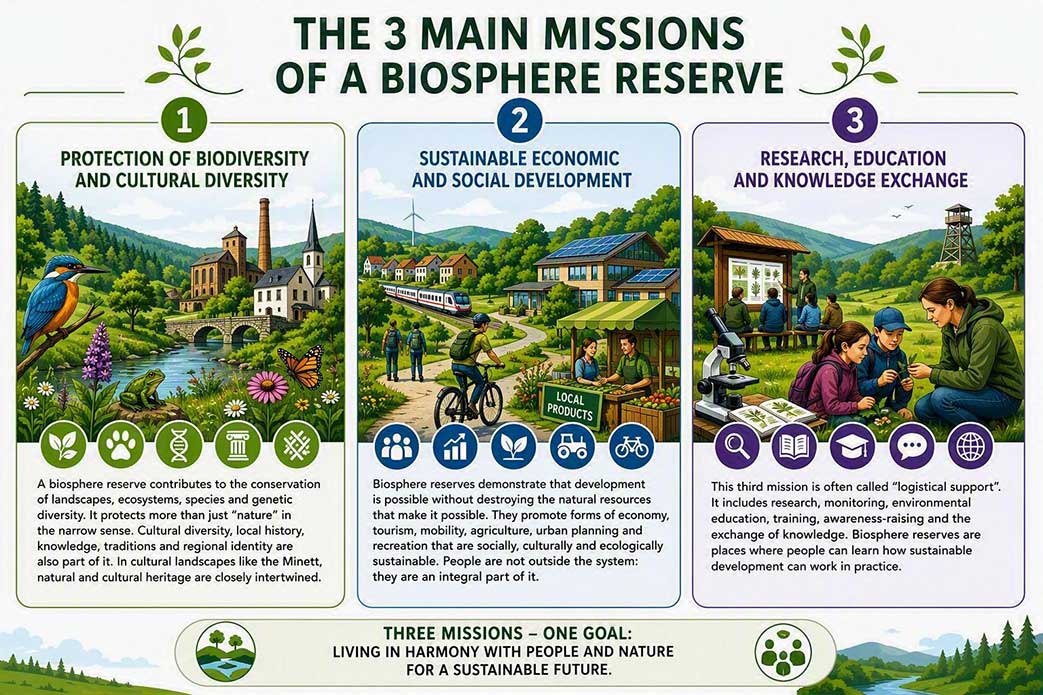
Biosphere reserves fulfil three central functions. These three missions form, in a sense, the foundation of the entire concept.
This graphic has been generated using AI
1. Protection of biodiversity and cultural diversity
A biosphere reserve contributes to the conservation of landscapes, ecosystems, species and genetic diversity. But it does not only protect “nature” in the narrow sense. Cultural diversity, local history, knowledge, traditions and regional identity also play an important role. In cultural landscapes such as the Minett, natural heritage and cultural heritage are closely connected.
2. Sustainable economic and social development
Biosphere reserves are intended to show that development is possible without destroying the natural foundations of life. This involves promoting forms of economy, tourism, mobility, agriculture, urban development and leisure activities that are socially, culturally and ecologically viable. People are therefore not outside the system, but fully part of it.
3. Research, education and knowledge exchange
The third function is often referred to as “logistic support”. This means research, monitoring, environmental education, training, awareness-raising and the exchange of knowledge. Biosphere reserves should be places where people learn how sustainable development can work in practice.
These three functions are also visible in the Minett UNESCO Biosphere. It promotes the protection of biodiversity and sustainable development through citizen participation, education and research. Locally, these missions are implemented in the fields of nature conservation, sustainable development, education, research and monitoring.
Zoning: core areas, buffer zones and transition areas
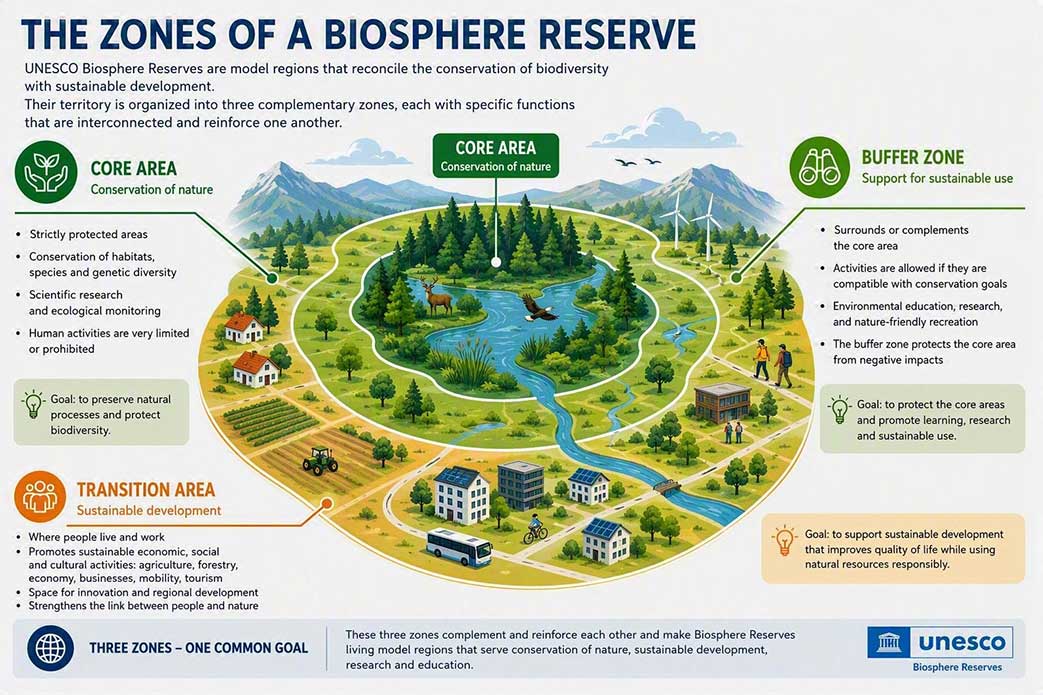
One of the essential features of every biosphere reserve is its zoning. In order to fulfil several functions at the same time, the territory is divided into three interconnected zones.
Core areas are particularly protected spaces. They primarily serve to preserve habitats, species and ecological functions. In these areas, nature conservation, research and monitoring are the main priorities. Activities are strongly limited in order to protect sensitive ecosystems.
Buffer zones surround or complement the core areas. Activities may take place there, provided that they are compatible with conservation objectives. These may include environmental education, research, nature-friendly use or certain forms of sustainable leisure activities. Buffer zones help protect core areas from negative influences.
Transition areas are the parts of the biosphere reserve where people live, work, move around, run businesses, attend schools or spend their free time. The aim here is to promote sustainable forms of development. This zone shows particularly clearly that biosphere reserves are not islands separated from everyday life, but inhabited and used landscapes.
This graphic has been generated using AI
In the Minett UNESCO Biosphere, this zoning is closely linked to the history of the region. The core areas include former open-cast mining sites that are now classified as nature reserves or Natura 2000 areas. The buffer zones are intended to reduce the negative impacts of human activities on the core areas. The transition area includes the remaining surfaces where people live and work.
Why biosphere reserves are more important today than ever
Biosphere reserves contribute to major global objectives, but they do so at the local level. They connect international strategies with concrete landscapes, municipalities and field projects. This is precisely where their strength lies.
They help protect biodiversity, make ecological connections visible, promote education for sustainable development and support regions in consciously shaping their future. At the same time, they provide a platform for cooperation. Within the World Network of Biosphere Reserves, experiences, knowledge and good practices are exchanged between regions. This network promotes international cooperation, capacity building and the dissemination of proven practices.
In 2026, following the designation of 14 new biosphere reserves, the global MAB network includes a total of 797 sites in 145 countries. Together, these territories cover around 7.5 million square kilometres. More than five percent of the Earth’s terrestrial surface is thus part of the network, and a large share of these territories overlaps with important biodiversity areas.
These figures show that biosphere reserves are no longer a niche topic. They form a global network of model territories seeking answers to one of the central questions of our time: how can we live well without endangering the natural foundations of our existence?
Luxembourg’s only biosphere reserve: the special role of the Minett
With the Minett UNESCO Biosphere, Luxembourg is part of this global network. The region was recognised as a biosphere reserve on 28 October 2020 and is the country’s first biosphere reserve.
The territory in southern Luxembourg covers around one tenth of the country and extends across a region shaped by iron ore mining, the steel industry, migration, urbanisation and cultural diversity. At the same time, it is home to important natural areas, former open-cast mining landscapes, forests, dry grasslands, wetlands, rock formations and a network of galleries and mine shafts that are of major importance, particularly for bats.
 |
The Minett UNESCO Biosphere is therefore not only a protected area, but also a place of learning. Here, one can observe how nature returns to former industrial sites, how biodiversity can be preserved close to densely populated areas, and how regional development, industrial culture, research, education and citizen participation can be connected.
The Minett UNESCO Biosphere includes the eleven PRO-SUD member municipalities: Bettembourg, Differdange, Dudelange, Esch-sur-Alzette, Käerjeng, Kayl, Mondercange, Pétange, Rumelange, Sanem and Schifflange. The management and development of the biosphere is therefore also an intermunicipal project that collectively considers the future of southern Luxembourg.
Discover all of the core zone of the Minett UNESCO Biosphere here.
A promise for the future
A UNESCO Biosphere Reserve is not a museum of nature. It is a promise: the promise to consciously develop one’s own territory. It invites us to consider landscapes not merely as surfaces, but as living environments, places of memory, spaces for learning and territories of the future.
For the Minett UNESCO Biosphere, this means that the history of the Red Earth, the mines, industry and immigration is not set aside. It is understood as an integral part of a living landscape in which nature and society together open up new perspectives.
The biosphere shows that sustainable development does not have to remain an abstract idea. It begins on the ground: in municipalities, in schools, in research projects, on hiking trails, in former mining sites, in cultural initiatives, in political decisions and in the everyday lives of residents.
This is precisely why the Minett UNESCO Biosphere is much more than an international label. It is a shared regional project. And it shows that a landscape shaped by human activity can also be a place where the future takes shape.